Case study

Condensate Filtration Upgrade for Gas CPP

Oil & Gas

Product

SupaPleat HFC

Client

Global Oil & Gas Production Company 

Application

Condensate Filtration

Location

Malaysia 

Value Added

Improved on-stream lifetime and asset protection

Sector

Oil & Gas

Background

The economics of a gas field extend beyond the gas itself. The hydrocarbon condensate recovered alongside natural gas is also a valuable product, making the reliability and efficiency of the condensate treatment process commercially important. Maintaining a clean condensate stream protects not only product quality but also the processing equipment required to turn that condensate into a stable, saleable product. 

Effective filtration is a key part of that protection. If sand and other solids are allowed to pass downstream, deposits and fouling can increase maintenance requirements and impair the performance of condensate processing equipment. Correctly specified filtration can therefore contribute directly to controlling OPEX and maintaining asset profitability. This becomes particularly important as a gas field matures and the contamination burden changes, as Amazon Filters discovered when investigating a condensate filtration problem on an established offshore gas field


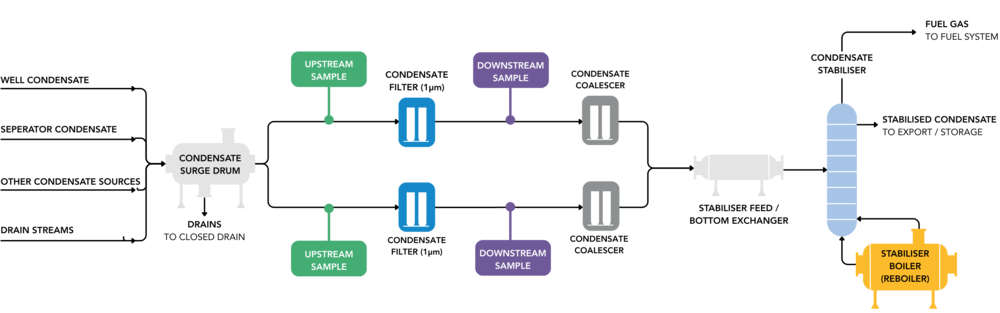
Simplified Condensate  Filtration  Process
Oil & Gas - Condensate (2)-1


The Challenge

The operator contacted Amazon Filters after sand and other particulate contamination was identified in downstream equipment, including the heat exchanger, reboiler and condensate stabiliser.

The field had been operating for approximately ten years. During the earlier years of production, when particulate loading was comparatively light, the original filtration arrangement had provided satisfactory service.

As operating conditions changed, however, the solids burden presented to the filtration system increased. The existing arrangement used a single 60-inch cartridge in each of two filter trains. Although the installed cartridges were rated at 1 micron, operational evidence showed that particulate was continuing to reach downstream process equipment.

The measured differential pressure across the condensate filter was low, indicating bypassing of the filter. The poor filtration performance was also evident on the downstream liquid liquid coalescers which showed significant physical damage (pictured)
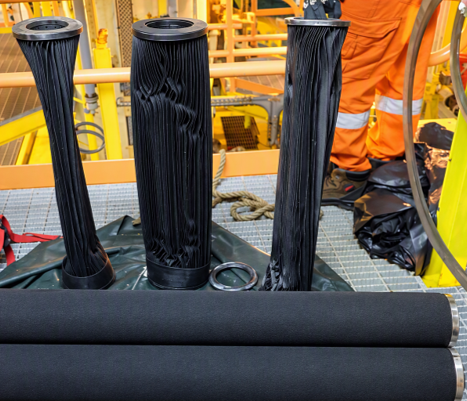
Coalescers crop

Investigating the Filtration Performance

A detailed assessment was undertaken to establish the extent of the contamination and evaluate the effectiveness of the existing filtration system.

Samples were collected from upstream and downstream of the two condensate filter trains. The investigation included:

    • Total Suspended Solids (TSS) analysis
    • Particle Size Distribution (PSD) analysis
    • Calculation of solids loading
    • Comparison of upstream and downstream contamination
    • Review of differential-pressure behaviour
    • Assessment of the installed filtration capacity

The condensate sample immediately downstream of the surge drum contained an average TSS concentration of 79 mg/L.  

The condensate samples taken directly after the two condensate filters were 123 mg/L and 261mg/L

These readings, in conjunction with the differential pressure across the filters not being elevated, show that the existing filter is shedding a large amount of particulate in addition to bypassing. 

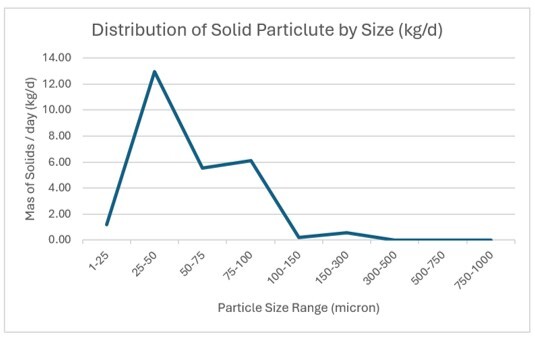
The particle size distribution for the condensate upstream of the filters indicated that although the number of particles at below 25 micron were the greatest numerically, the ones from 25-50 contributed to the greatest mass. This indicated a significant loading on the filters system amounting to 26.52kg/day.

The existing system of a single 60" filter element was therefore significantly undersized resulting in frequent blocking , associated increase in difference pressure and ultimately damage to the filter and breakthrough of particulate to downstream processes.

solid distribution

The Engineering Recommendation

The main issue identified was the dirt holding capacity of the system rather than the efficiency rating. With this in mind it was recommended to retain the 1 micron rating (SupaPleat HFC)to ensure protection and efficiency of  downstream equipment while substantially increasing the available filtration area. 

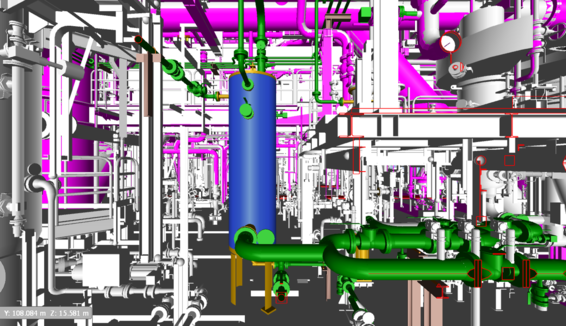
A 9 round 60" system was  initially proposed in a horizontal configuration. However, the available envelope of space on the Central Processing Platform could not accommodate this format. As Amazon Filters design an fabricate pressure vessels in house we were able to work with operator and move to a vertical layout and design unit to 'plug and play' into existing pipework.

Installation render for Chevron


As the problems with the existing filtration system were causing significant added operational costs due to premature blockage and process equipment contamination, the customer was provided with opportunity to rent a skid unit (capable of processing 10KBD) while the new housings were being fabricated. This ensured the process could run efficiently until the permanent solution was installed.

Key takeaways

  1. Process conditions can change considerably over time. It is prudent to evaluate performance of filtration systems on a frequent basis as part of the preventative maintenance progamme
  2. Understanding the nature of the contamination to be removed in terms of particle size distribution and mass loading is paramount in recommending a robust future proof-filtration system
  3. Micron rating alone does not determine filtration performance. Filtration area and solids handling capacity must also match the process duty

Let's get started

Is your condensate system still sized for current operating conditions?