Introduction
The implementation of Directive (EU) 2020/2184 has introduced a more comprehensive, harmonised and risk-based approach to drinking water management across Europe. While much of the industry attention has focused on emerging contaminants and new monitoring requirements, one of the most significant operational implications for water treatment operators is the increased emphasis placed on treatment performance and the maintenance of effective microbiological barriers.
Central to this approach is turbidity control.
Turbidity has traditionally been viewed as an indicator of water clarity. Today it is increasingly recognised as a critical operational parameter that directly influences the effectiveness of downstream disinfection systems such as ultraviolet (UV) treatment and chlorination. Industry guidance associated with the recast Directive highlights a treatment works reference value of approximately 0.3 NTU in 95% of samples, reflecting the importance of maintaining consistently low particulate levels within treated water.
For water utilities relying on groundwater and borehole-derived supplies, this creates renewed interest in filtration technologies capable of delivering stable, predictable turbidity reduction.
Why Turbidity Matters
The relationship between turbidity and disinfection performance is well established. Fine suspended particles can shield microorganisms from UV irradiation, reduce the efficiency of chemical disinfectants and provide refuges in which pathogens can survive treatment processes.
As a result, turbidity should not simply be viewed as an aesthetic parameter. It is increasingly recognised as a key measure of treatment effectiveness and overall process control. Utilities investing in UV disinfection systems are under particular pressure to ensure that upstream filtration consistently maintains low particulate loading.
The move towards online monitoring and risk-based process validation further increases the visibility of short-duration turbidity excursions that may previously have gone unnoticed. Consequently, treatment operators are looking for solutions capable of providing reliable particle removal under a wide range of operating conditions.
Groundwater Treatment Challenges
The majority of European municipal groundwater treatment plants continue to rely upon pressure media filtration for the removal of iron, manganese and suspended solids.
A typical treatment process involves:
• Aeration or oxidation
• Precipitation of dissolved iron and manganese
• Media filtration
• UV or chemical disinfection
This approach is proven and widely adopted. However, performance can vary according to media condition, hydraulic loading, backwash effectiveness and raw water variability.
Iron and manganese removal remains one of the most common treatment requirements for groundwater-derived drinking water across Europe. Technical reviews continue to identify sand, anthracite, catalytic media and manganese oxide-coated materials as the dominant filtration technologies used within these applications.
While these systems can achieve excellent treatment results, maintaining consistently low turbidity throughout the operating cycle can be challenging, particularly where oxidised metal particles are fine or variable in size.
Cartridge Filtration – A Practical Alternative
Cartridge filtration should not be viewed as a replacement for rapid gravity filtration operating on large surface-water treatment works. The flow rates associated with many reservoir-fed plants remain better suited to conventional clarification and media filtration technologies.
Groundwater treatment presents a different opportunity.
Lower flow rates, reduced solids loading and specific treatment requirements such as oxidised iron and manganese removal make cartridge filtration a practical and increasingly attractive alternative.
Compared with conventional pressure media filtration, cartridge filtration offers several advantages:
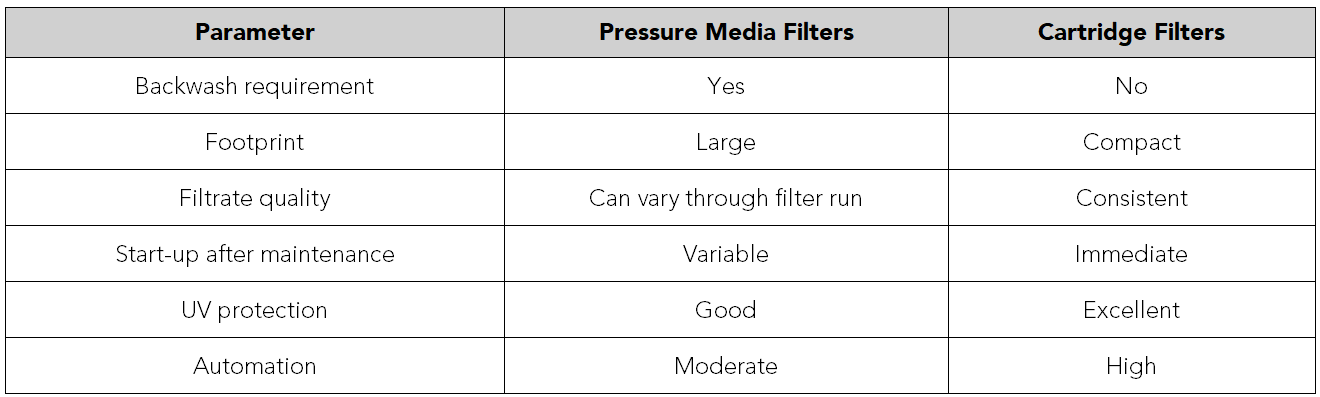
For groundwater applications, cartridge filtration can provide a predictable particulate barrier that supports low turbidity operation ahead of UV disinfection systems. It can also act as an effective polishing stage for removing fine precipitated iron and manganese particles that may escape conventional treatment processes.
Case Study: Cartridge Filtration for Groundwater Turbidity Control
A municipal water treatment plant drawing from groundwater sources experienced variable turbidity following oxidation and conventional media filtration. Although the existing process was effective at removing the majority of iron and manganese, fine particulate breakthrough was occasionally observed during changes in raw water quality and following operational disturbances.
The treatment works installed cartridge filtration as a polishing stage downstream of media filtration and upstream of UV disinfection. The objective was to provide a more consistent particulate barrier, reduce short-duration turbidity excursions and improve confidence in UV performance.
Following installation, the cartridge system provided stable differential pressure behaviour and predictable particulate removal. Operators were able to maintain low treated-water turbidity more consistently, helping to protect downstream UV disinfection from the risk of particle shielding.
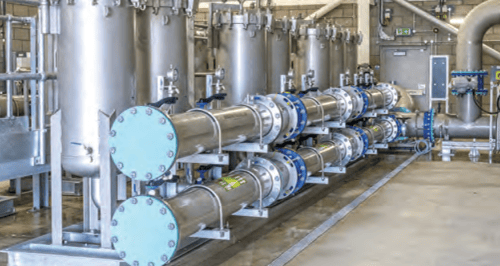 The case demonstrates how cartridge filtration can complement existing groundwater treatment assets rather than replace them. Used as a final polishing stage, it can provide an additional level of process security where low turbidity is essential for disinfection assurance.
For European groundwater operators, this type of application is particularly relevant as treatment expectations become more risk-based and as utilities seek robust, certified technologies that can support consistently low turbidity ahead of UV treatment.
Harmonised Approvals and DVGW Certification
Historically, one of the barriers to adopting new treatment technologies across Europe has been the fragmented approval landscape for materials in contact with drinking water.
Products routinely required separate approvals under national schemes such as DVGW in Germany, ACS in France, KIWA in the Netherlands and WRAS in the United Kingdom. While all sought to protect public health, the differing requirements increased cost and complexity for manufacturers serving multiple European markets.
The harmonised Drinking Water Directive addresses this issue through the introduction of common hygiene requirements for products in contact with drinking water. Article 11 establishes the framework for a more consistent European approach to assessing materials used within potable water systems.
The objective is to ensure that materials:
• Do not compromise human health
• Do not promote microbial growth
• Do not release harmful contaminants
• Do not adversely affect taste, odour or appearance
For filtration equipment, compliance increasingly extends beyond filtration performance alone. Utilities and consulting engineers must also demonstrate that housings, filter media, seals and associated materials are suitable for long-term drinking water contact.
DVGW certification remains one of the most widely recognised drinking water approvals within Europe. Recent certification developments have extended DVGW approval to include 316L stainless steel filter housings and approved drinking water filter cartridge constructions, providing an additional level of confidence for utilities evaluating cartridge filtration technologies for municipal drinking water applications.
As Europe moves towards harmonised approval standards, independently certified filtration equipment is expected to experience fewer regulatory barriers and wider acceptance throughout the municipal water sector.
Conclusion
The harmonised Drinking Water Directive has strengthened the focus on risk-based drinking water management and reinforced the importance of turbidity as a critical process control parameter.
For large surface-water treatment works, conventional media filtration technologies will remain dominant. However, groundwater and borehole-derived supplies present a different challenge.
Here, the need for reliable iron and manganese removal, stable low turbidity and effective UV disinfection creates a strong case for alternative filtration approaches.
Cartridge filtration offers a compact, predictable and operationally simple solution capable of delivering consistent particulate removal and supporting modern drinking water treatment objectives. The technology is already established within the UK municipal water sector and has demonstrated its value across a range of groundwater treatment applications.
Combined with the growing availability of recognised drinking water approvals such as DVGW certification and the wider harmonisation objectives of Directive (EU) 2020/2184, cartridge filtration is increasingly well positioned as a credible technology for European municipal groundwater treatment applications.



